What speed to lead actually means
Speed to lead is the elapsed time between a customer reaching out and your business making its first meaningful response.
Speed to lead = time of first meaningful response − time the enquiry arrived.
Two details matter. First, the clock starts when the phone rings or the form is submitted, not when you next check your messages. Second, 'meaningful' means a real conversation, a qualified reply or a booked job. An automatic 'thanks for your message' text doesn't stop the clock because nothing has moved for the customer.
For a trade business this is simple to say and hard to do. If your average response is 'when I'm out of the roof cavity', your speed to lead is however long that takes.
What the research says
Two pieces of work sit behind almost every speed-to-lead statistic you see quoted online. Both were led by James Oldroyd and both were about sales leads rather than trade enquiries.
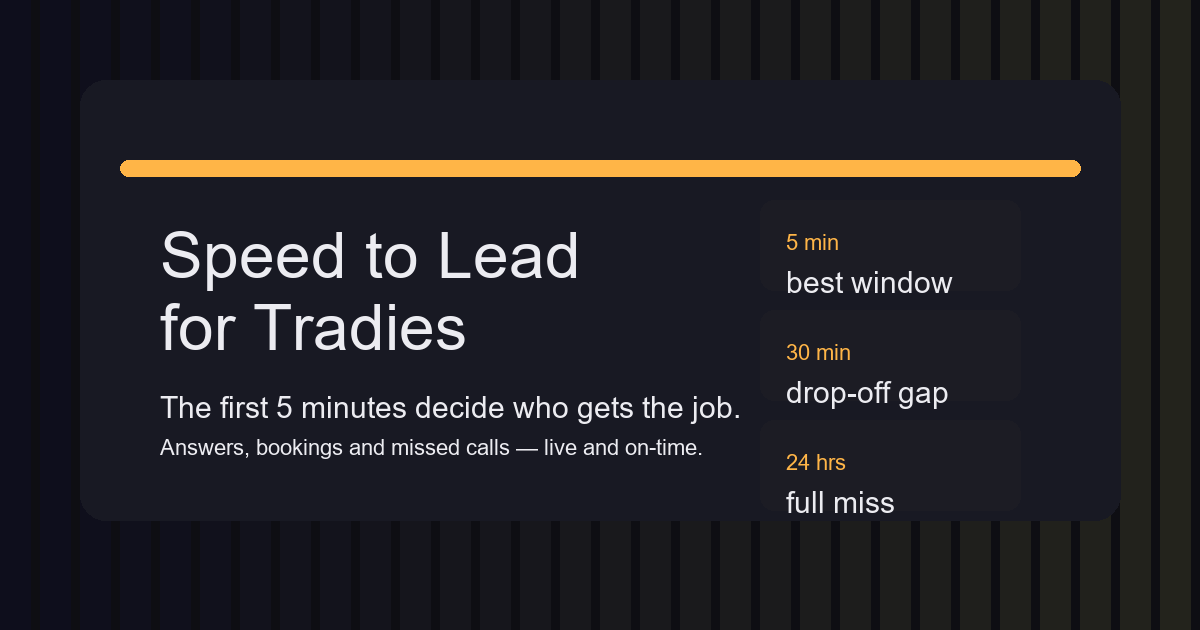
- 5 minutes: In the 2007 Lead Response Management study, the odds of qualifying a lead were 21 times better when the first contact attempt came within 5 minutes than after 30. The odds of simply making contact were about 100 times better.
- 30 minutes: The same study found the odds of qualifying a lead fell by more than six times across the first hour.
- 1 hour: Firms that responded within an hour were nearly seven times as likely to qualify a lead as firms that waited even one hour longer.
- 24 hours or more: Firms that waited a day or longer were about 60 times less likely to qualify the lead than firms that responded within the first hour.
The details matter. These studies were mostly US sales-lead studies and they're between 15 and 19 years old, so 5 minutes and 30 minutes are best treated as thresholds, not a perfectly smooth curve. What holds up is the direction: results fall quickly as the wait grows, and most businesses respond far more slowly than they think.
Why trades feel it harder
In most industries, speed to lead is about how fast a rep follows up on a form. In trades, the phone is the form. The customer is already on the line, which means the window isn't five minutes; it's the length of one ring cycle, and then it's gone.
The missed-call numbers are worth knowing. CallRail's 2025 benchmark found the home services missed-call rate was 14%, and the same report found that up to 85% of unanswered callers won't call back. That means one missed call is often not one lost customer. It's a lost customer and a lost referral path.
Emergencies make this even more expensive. A 2025 HomeServe survey found that 81% of US homeowners had a home repair emergency in the past year. That matches the reality for many Australian trade businesses: demand arrives when the phone is off, the hands are busy, or the customer is already moving to the next result.
Where the first five minutes go
Almost no trade business ignores the phone on purpose. Speed disappears in four predictable places.
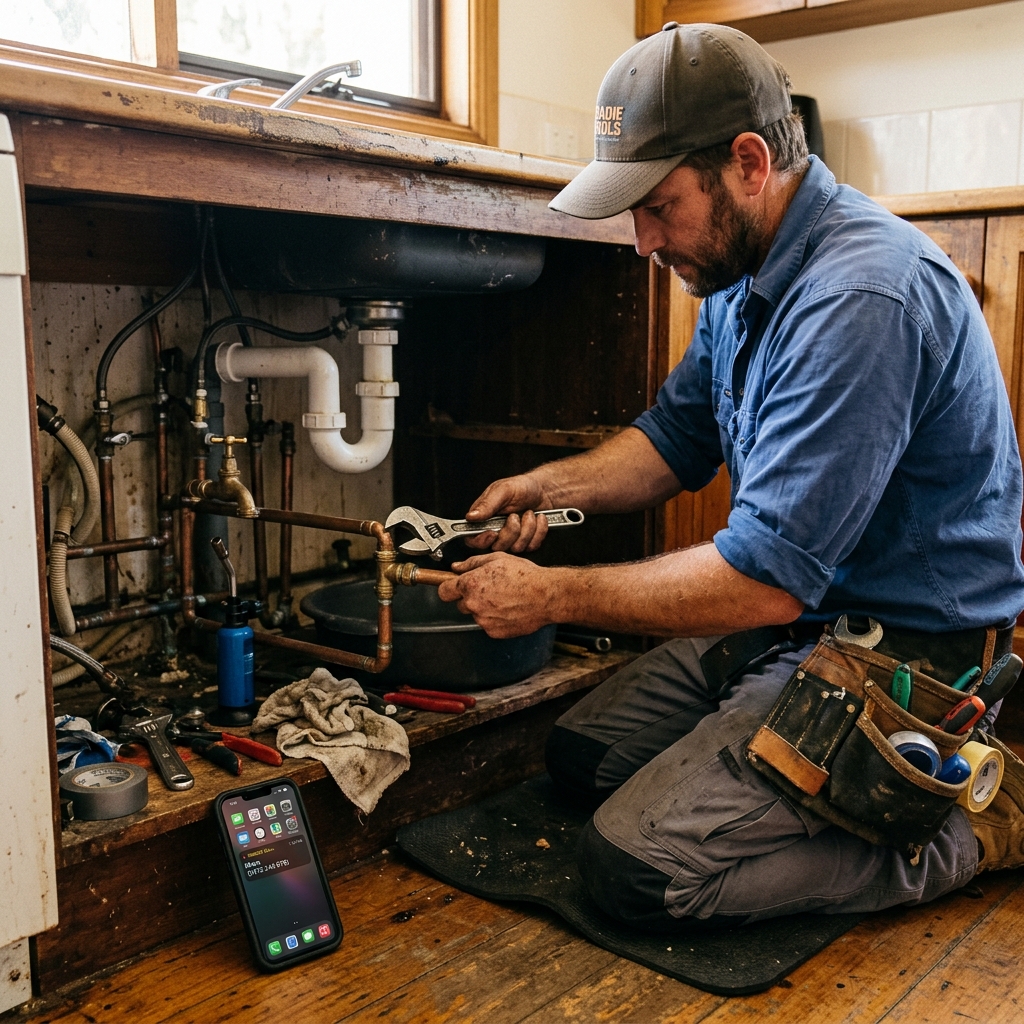
- On the tools: You can't safely answer a call with your hands in a ceiling, on a roof or around a gas line. Driving between jobs isn't any better.
- After hours and weekends: Emergencies don't check the time. Most tradies silence their phones to sleep, but that is exactly when urgent calls land.
- The second call: During business hours, a second customer ringing while you're already on a call goes straight to voicemail. Busy days make this happen most.
- Voicemail itself: A message promising a callback is competing against a business that answered live. Someone with a burst pipe at 9pm isn't waiting until morning to call back.
What slow actually costs
You can put a rough number on it in five minutes. Pull a week of calls from your phone provider, count the unanswered ones, and work out how many would normally have turned into a booked job:
Missed calls per week × share that would have booked × average job value × 52 weeks.
Worked example
- Missed calls per week: 5
- Share that would have booked: 40%
- Average job value: $350
- Lost per week: $700
- Lost per year: $36,400
Illustrative numbers only. Swap in your own call count, close rate and job value.
If you'd rather not do the arithmetic by hand, use Vectolift's free calculator to estimate the cost in your business. The broader point is simple: missed calls are rarely a tiny problem. They are usually a meaningful chunk of your annual revenue.
Coverage options compared
Voicemail
- Live answer: no
- After hours: records only
- Books the job: no
Mobile diversion
- Live answer: if you can pick up
- After hours: if you're awake
- Books the job: if you can check your diary
Human answering service
- Live answer: yes
- After hours: yes
- Books the job: sometimes
AI receptionist
- Live answer: yes
- After hours: yes
- Books the job: yes, when linked to your calendar
None is perfect. The right answer depends on your call volume, after-hours demand and how often the caller needs a definitive answer on the spot.
A practical speed-to-lead playbook for a trade business
- Set a target and define what counts. Answering live is the goal. When that isn't possible, aim for a meaningful response within five minutes.
- Measure for two weeks. Count missed calls, split them by business hours and after hours, and note how long each took to return.
- Close the biggest gap first. For most trades that's after hours and 'on the tools', because that's where urgent, higher-value calls land.
- Triage on the first call. Separate emergencies from routine jobs. A burst pipe should alert you immediately. A quote request can wait until morning.
- Book while the customer is still on the line. The best response isn't 'we'll call you back'—it's a confirmed time in your calendar.
- Text back what you miss. Some calls will still slip through. A quick text within minutes keeps the conversation alive while the customer is still deciding.
Where an AI receptionist fits
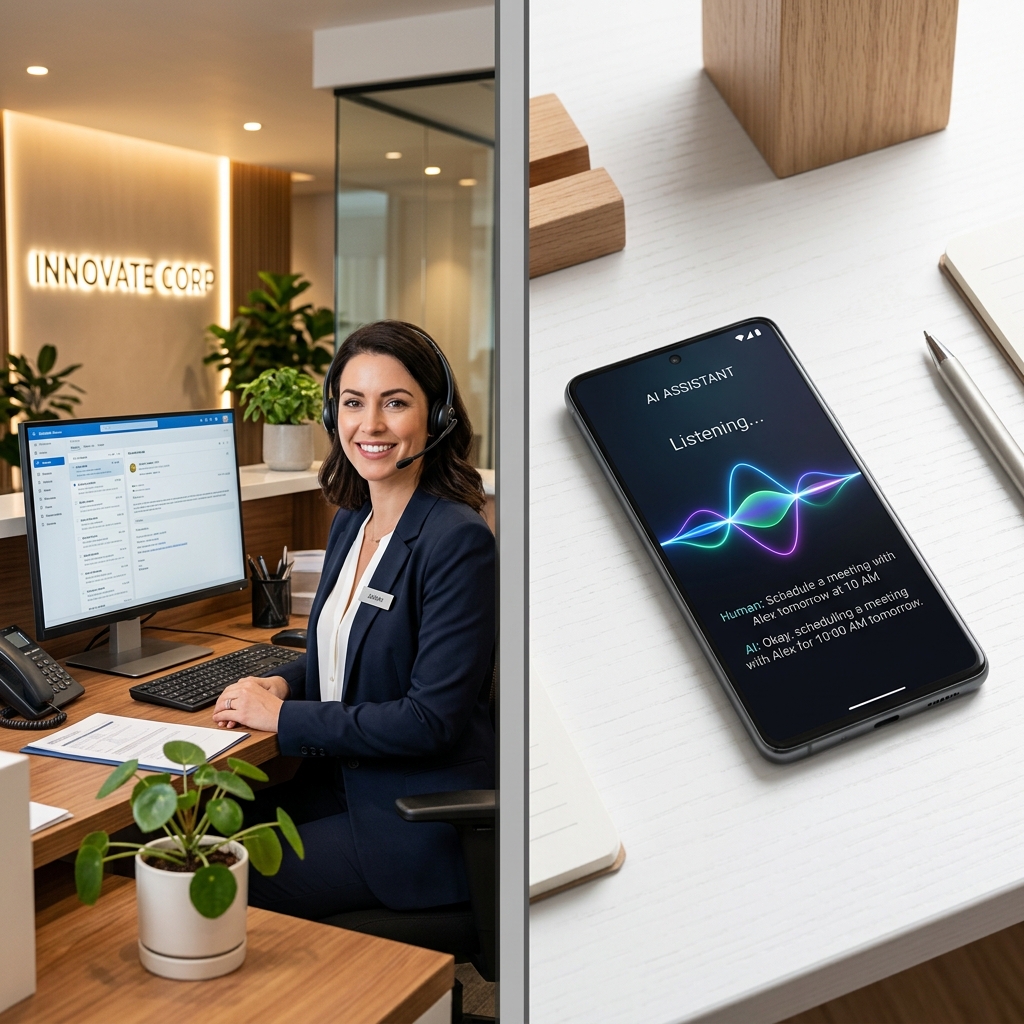
An AI receptionist is one way to cover steps three to five without hiring a person or giving up your sleep. Vectolift answers every call with a natural Australian-accented voice, responds in under 600 milliseconds on average, recognises urgent requests like burst pipes, and can send an immediate SMS alert when action is needed.
It can also book routine jobs directly into Cal.com or Google Calendar, which keeps the customer talking and reduces the 'I’ll just call someone else' problem. It isn't a replacement for a real person. Unusual or highly specific questions still need a human, so a good setup spells out when to hand over and how quickly that will happen.
For detailed trade-specific examples, see our guides for plumbers and electricians.