The Real Reason This Decision Got Harder in 2026
For most of the last two decades, a small trade business with too many calls and not enough hands had one real option: hire someone, or don’t. Hiring got harder well before AI receptionists became a realistic alternative, and it’s worth understanding why, because it explains why this comparison exists at all right now.
Jobs and Skills Australia’s 2025 Occupation Shortage List — released in October 2025 and covering more than 1,000 occupations — found that roughly 29% of assessed occupations are in national shortage, concentrated heavily in trades, health, technology and community services. Electricians are one of the worst-affected trades specifically: the same agency’s forecasting puts the additional need at around 32,000 electricians by 2030 and roughly 85,000 by 2050, driven by electrification, housing and renewable energy targets. Plumbers, HVAC technicians and other licensed trades sit in a broadly similar position for similar reasons — training pipelines that take years to produce a qualified worker, against demand that’s growing faster than that pipeline can fill.
None of that shortage data is about receptionists specifically. But it matters here for a simple reason: a trade business that’s already struggling to find a second technician is not about to prioritise hiring dedicated front-desk staff, even when missed calls are visibly costing it work. The admin role gets absorbed by whoever’s free — usually the owner, at 9pm, between jobs.
At the same time, customers have quietly stopped tolerating the old trade-off. Two decades of same-day delivery, rideshare apps and instant online booking have reset what “normal” response time looks like, and that expectation doesn’t switch off just because someone’s standing in a flooded laundry. Voice AI has also crossed a genuine quality threshold in the last couple of years — natural-sounding speech, low-latency responses, and models that can follow an actual triage conversation rather than a rigid phone tree — which is the only reason “AI receptionist” is a credible third option at all, rather than the robotic voicemail-with-extra-steps it would have been five years ago.
Three Ways to Answer the Phone (and What Each One Really Means)
Strip away the marketing on both sides and a trade business is really choosing between three structures, not two:
No dedicated coverage. The phone rings through to the owner, a technician, or voicemail. This is where most solo operators and very small teams start, usually without deciding to — it’s just what happens by default.
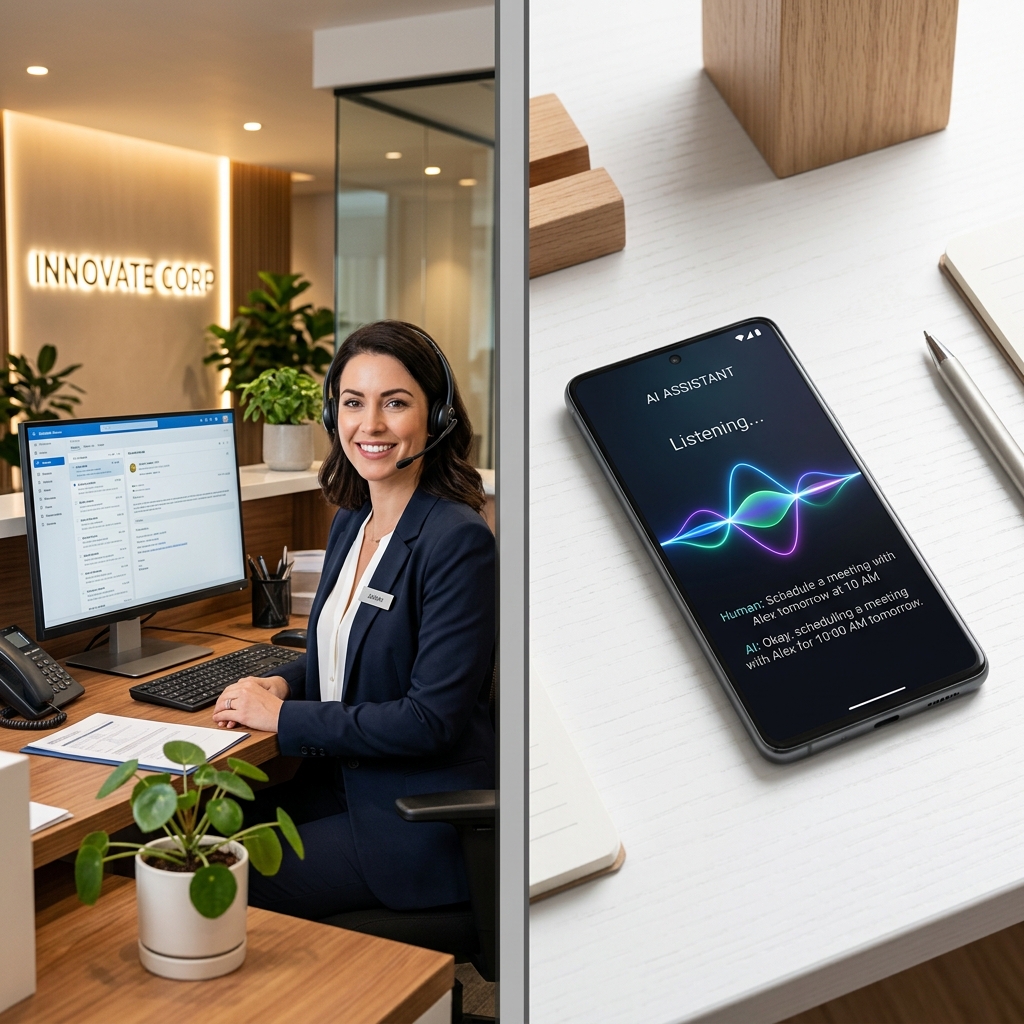
A human receptionist, either employed directly or contracted through a traditional outsourced answering service. A real person answers, takes a message or books a job, and hands it off.
An AI receptionist — software that answers using natural-sounding voice, understands the request, and can book directly into a calendar or job-management system without a person in the loop for routine calls.
Most comparisons stop at “AI vs. human” and skip the fact that outsourced human answering services are a genuinely distinct option with their own cost structure and their own failure modes, separate from hiring someone directly. All three are compared properly below, with numbers rather than adjectives.
What a Human Receptionist Actually Costs in Australia
This is the number almost every AI-receptionist marketing page gets vague about, so let’s not be vague.
Most receptionist and front-desk admin roles in Australia’s private sector fall under the Clerks – Private Sector Award 2020 (MA000002), the default modern award for clerical and administrative work, including receptionists, office managers and call-centre operators. From the first full pay period on or after 1 July 2026, the base rate for a Level 1 (entry-level, supervised) employee is $26.97 an hour full-time or part-time.
| Cost component | Basis | Annual amount (approx.) |
|---|---|---|
| Base wage | $26.97/hr × 38 hrs/week × 52 weeks | ≈ $53,290 |
| Annual leave loading | 17.5% on 4 weeks’ annual leave | ≈ $720 |
| Superannuation guarantee | 12% of ordinary time earnings | ≈ $6,400 |
| Estimated minimum annual cost | ≈ $60,400 |
That’s the legal floor — before recruitment and onboarding, before paying for sick leave and annual leave cover, before a laptop, a desk, or a share of the office electricity bill, and before a single dollar of turnover cost if the hire doesn’t work out. It also assumes a straightforward Level 1 classification; a receptionist handling more judgement-based work sits at Level 2 instead, which starts from $29.45 an hour and pushes the same calculation past $65,000.
And that entire figure only buys standard business hours. The Award requires a 2× penalty rate for Sunday work ($53.94/hr at Level 1) and 2.5× for public holidays ($67.43/hr), on top of evening and Saturday loadings — which is exactly why almost no small trade business rosters a human receptionist for genuine 24/7 or weekend coverage.
What an Outsourced Answering Service Costs — and Where It Falls Short
Before AI receptionists existed, the standard fix for after-hours or overflow coverage was a traditional outsourced answering service: a call centre, often shift-based, taking messages on your behalf. These still exist and still get sold hard to trade businesses, so they’re worth pricing properly rather than dismissing.
Across the market, human-staffed answering and virtual-receptionist services typically bill one of two ways: a per-minute rate, commonly landing somewhere between roughly $1.50 and $2.50 a minute once you’re past a small included allowance, or a per-call rate in the region of $8–15 once add-ons like appointment booking or CRM syncing are included. Either way, cost scales directly with how much you use the service — which is the opposite of what a trade business wants during its busiest, most profitable weeks.
The bigger issue for trade businesses specifically usually isn’t the price, though. It’s fit. A generalist answering-service operator, working from a script across dozens of unrelated client businesses, typically can’t tell a routine tap-washer enquiry from an actual gas leak, doesn’t know your callout pricing unless you feed it to them constantly, and can’t make a judgement call about which after-hours job is worth waking you up for. Most take a message and promise a callback rather than booking anything directly, which quietly reintroduces the exact delay this whole exercise was meant to remove.
What an AI Receptionist Costs (and What You’re Actually Paying For)
The AI phone-answering market has grown quickly enough that pricing now spans a wide range, and the billing model matters as much as the headline number. Broadly, three structures show up across the market: flat-rate plans with a call or minute cap and overage fees once you exceed it, genuinely unlimited flat-rate plans, and hybrid AI-plus-human-backup plans that bill per call and tend to sit at the premium end — often $250–300+ a month once real call volume is factored in. Pure AI-only plans built for straightforward call handling generally start much lower, often in the $30–100 a month range for modest volumes.
What’s worth asking any provider directly is whether pricing is flat-rate or usage-based. A flat monthly fee means a genuinely busy stretch — a heatwave for an HVAC business, a burst-pipe weekend for a plumber — doesn’t come with a surprise invoice, which matters more for trade businesses than almost any other type of customer, since demand spikes are exactly when the extra calls are most valuable.
The other thing you’re paying for, whether or not it’s itemised anywhere, is voice quality and integration depth. Cheap, generic AI phone bots tend to use noticeably synthetic voices, respond with an awkward pause that makes the call feel robotic, and run generic scripts that don’t recognise trade terminology like “switchboard,” “downpipe” or “hot water system.” Response latency in particular is worth asking about in hard numbers, not adjectives: a round-trip delay of even a second or two is enough for most people to register that something’s off.
Side by Side: Cost, Coverage and Capability Compared
| Factor | No coverage | Human (in-house) | Outsourced answering | AI receptionist |
|---|---|---|---|---|
| Annual cost (AUD) | $0 direct, high opportunity cost | ~$60,000+ (biz hours only) | ~$500–$1,800+, scales with volume | Flat monthly fee |
| Coverage | Unreliable, ad hoc | Rostered business hours only | Often 24/7, but scripted | Genuinely 24/7, consistent |
| Typical answer speed | Whenever someone’s free | Seconds, during hours | Minutes, queue-dependent | Seconds, every time |
| Books the job directly | No | Yes, with training | Rarely — usually takes a message | Yes, if integrated |
| Trade-specific triage | N/A | Yes, with experience | Rarely | Depends on the provider |
| Handles emotional calls | N/A | Best option | Inconsistent | Should escalate, not attempt |
| Scales during spikes | No | No — one person, fixed hours | Usually | Yes |
| Setup time | None | Weeks, for recruitment | Days | Often under a day |
No option wins every row, deliberately. That’s the honest picture.
Where AI Receptionists Genuinely Still Fall Short
A comparison that only lists advantages for one side isn’t a comparison, so here’s where a human still matters, without hedging.
Genuinely distressed callers. Someone who’s just had a house fire, a serious injury, or a burst pipe flooding a nursery at 2am isn’t always going to get useful help from a triage flow, however well designed. Good AI receptionist systems are built to recognise distress and escalate immediately to a real person by SMS or call rather than trying to talk someone through it — but that’s a deliberate design choice a provider has to make, and it’s worth confirming rather than assuming.
Unusual or ambiguous requests. A voice AI trained on plumbing and electrical triage will handle “my hot water isn’t working” extremely well and “can you also quote re-stumping the back deck while you’re here” considerably less well. Anything genuinely outside the trained scope should be captured and handed to a human, not guessed at.
Customers who are uncomfortable with AI. Some callers, disproportionately older customers, will want to know immediately whether they’re talking to a person, and some will disengage once they find out they’re not. Being upfront about it, rather than trying to pass the AI off as human, is both the more honest approach and, anecdotally, the one that causes fewer complaints.
Accountability when something goes wrong. If a receptionist mishears an address or under-quotes a job, there’s a well-understood process for sorting it out with an employee. With software, that same mistake raises a fair question about who’s responsible and how quickly it gets fixed — which is exactly why a defined, fast human-escalation path matters more for an AI receptionist than almost any single feature on a spec sheet.
None of this is an argument against AI receptionists. It’s an argument for choosing one that’s honest about its own limits, rather than one marketed as a complete replacement for judgement.
Do the Maths for Your Own Business
Rather than quoting a single “trade businesses lose $X a year” figure — you’ll find plenty of those elsewhere, often without much explanation of where the number actually came from — it’s more useful to hand you the formula and let your own numbers do the talking:
Missed calls per month × realistic conversion rate × average job value = estimated monthly revenue at risk.
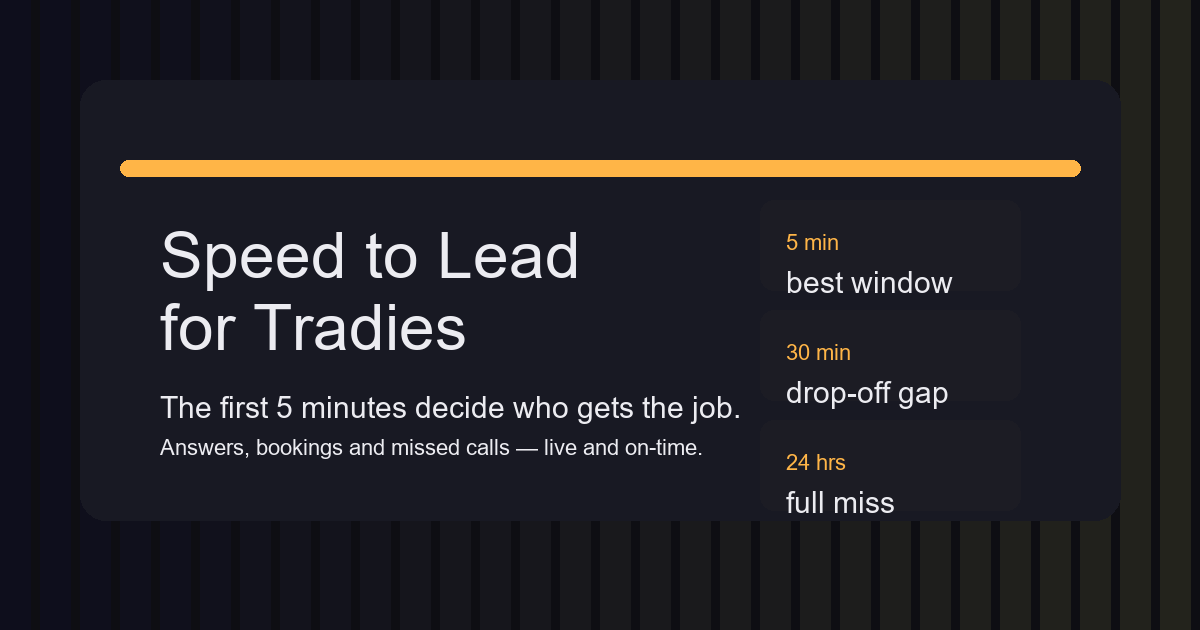
Your missed-call count is usually higher than it feels, because you don’t see the calls you don’t answer — voicemail and abandoned calls are invisible unless you’re actively tracking them. Conversion rate matters more than most people assume: a widely cited study published in the Harvard Business Review found that firms attempting contact with a new sales lead within an hour were roughly seven times more likely to qualify it than firms that waited even 60 minutes, and around 60 times more likely than firms that waited 24 hours or more.
If you’d rather not do the arithmetic by hand, Vectolift’s free calculator runs this same formula against your own call volume and average job value in about thirty seconds.
The other side of the equation is the structural cost comparison from earlier in this article: roughly $60,000 minimum for business-hours-only human coverage, against a flat monthly fee for AI coverage that also runs nights, weekends and public holidays without penalty rates. For most trade businesses, the AI option doesn’t need to win every single missed-call scenario to be worth it financially — it just needs to convert a handful of after-hours or overflow jobs a month that would otherwise have gone to voicemail, or to a competitor who happened to pick up first.
How to Evaluate an AI Receptionist Provider: A Buyer’s Checklist
If you’ve decided an AI receptionist is worth trying, the providers themselves vary a lot more than the pitch decks suggest. Questions worth asking before you sign anything:
- Is pricing flat-rate or usage-based? Ask specifically what happens in an unusually busy week or month — that’s precisely when you need the coverage most and can least afford a surprise bill.
- Can you hear a real, unscripted call before committing? A curated demo reel tells you very little about how the system handles an actual, slightly confused customer.
- What’s the actual response latency? Ask the provider to state it in milliseconds, not adjectives. Anything noticeably above a second tends to feel robotic in practice.
- Does it understand Australian trade vocabulary, or is it a generic US-built model with a different accent bolted on top?
- What’s the human escalation path, and how fast does it actually trigger for a genuine emergency versus a routine enquiry?
- Where is call data stored, and how is recording consent handled? Under Australia’s mix of Commonwealth and state surveillance and privacy law, callers generally need to be told a call may be recorded.
- What does it actually integrate with — a shared calendar slot, or a fully booked job with the correct customer details in your job-management software?
- Can you keep your existing business number, and what’s the real contract term if it doesn’t work out?
None of these questions are unique to any one provider, including us. They’re worth asking regardless of who you’re evaluating.
Where Vectolift Fits Into This
We’re not going to pretend to be neutral about this part, so we’ll keep it short and stick to what’s actually true rather than what sounds impressive.
Vectolift is built specifically for Australian home service businesses rather than adapted from a generic US small-business tool: the voice is a natural Australian accent built on ElevenLabs’ voice technology, average response latency is under 600 milliseconds, and the system is designed to recognise emergencies — a burst pipe, a gas leak — and escalate immediately by SMS rather than trying to handle them itself. It connects to calendar tools like Cal.com and Google Calendar so a booking lands directly in your diary rather than becoming a message you still have to action later, and calls are recorded with consent and stored to meet Australian privacy standards.
Whether that’s the right fit for your business is a genuinely separate question from everything above it in this article, and the honest answer depends on your call volume, your trade, and how much of it you’re currently losing to voicemail. Run your own numbers on the calculator, or get in touch if you’d rather talk it through first.
Frequently Asked Questions
Is an AI receptionist actually better than just using voicemail?
For after-hours and overflow calls, almost always. The research on response time is unambiguous about speed mattering, and voicemail is the slowest possible response by definition, since it requires the customer to hang up and wait for a callback rather than getting an answer immediately. The comparison is closer during business hours if you already have someone available to pick up promptly.
Will my customers know they’re talking to an AI?
A well-built system will generally disclose this if asked directly, and shouldn’t try to pass itself off as human. Most customers care less about whether it’s AI than whether their problem gets solved quickly, but transparency matters for trust, especially with older or repeat customers.
Is it legal to record calls handled by an AI receptionist in Australia?
Generally yes, provided callers are told the call may be recorded and, in most states and territories, give their consent — Queensland has a narrower exception, since one-party consent is generally sufficient there. This is general information, not legal advice; a business with specific compliance requirements should confirm its obligations directly with a qualified adviser.
Can an AI receptionist actually handle a real emergency, like a gas leak?
A properly built one should recognise the emergency, gather the essential safety details, and escalate to a human immediately by SMS or call, rather than attempting to resolve it through conversation alone. That escalation speed and reliability is one of the most important things to test before choosing a provider, not something to take on faith.
How long does it take to set up an AI receptionist for a trade business?
Providers built for this market generally aim for same-day setup, since most trade businesses can’t afford a long onboarding process. What varies more is how long it takes to properly train the system on your specific pricing, service area and terminology — worth asking about directly, rather than assuming “set up” means “fully accurate from day one.”
The Bottom Line
There isn’t a universally correct answer here, whatever any single vendor’s landing page tells you. A human receptionist costs roughly $60,000 minimum for business-hours-only coverage under Australian award rates, offers judgement an algorithm can’t fully replicate, and structurally can’t cover nights and weekends without a lot more money. A traditional outsourced answering service fills some of that after-hours gap but usually can’t book a job directly and rarely knows your trade well enough to triage it properly. An AI receptionist can offer genuine 24/7 coverage at a fraction of the human cost, provided you choose one that’s honest about what it can’t do and has a real plan for the calls it shouldn’t try to handle alone.
The actual decision comes down to your call volume, how much of it happens outside business hours, and how much a missed after-hours callout is really worth to your business. That’s genuinely a two-minute calculation, and you don’t need to take our word for any of it — run your own numbers here.
Sources referenced: Jobs and Skills Australia (Survey of Employers who Recently Advertised, 2025 Occupation Shortage List, Clean Energy Capacity Study); Fair Work Commission, Clerks – Private Sector Award 2020 (MA000002); Australian Taxation Office, superannuation guarantee rate; Oldroyd, McElheran & Elkington, “The Short Life of Online Sales Leads,” Harvard Business Review, March 2011; the 2007 Lead Response Management Study (Dr. James Oldroyd); publicly published pricing of comparable providers, reviewed September 2026; the Commonwealth Telecommunications (Interception and Access) Act 1979 and state/territory surveillance device legislation.
This article provides general information current as of September 2026 and isn’t legal, financial or employment advice — award rates, tax rules and privacy law can change, and vendor pricing changes even more often. Confirm current figures directly with Fair Work, the ATO, or the provider in question before making a decision.