What Traditional Answering Services Actually Do — In Detail
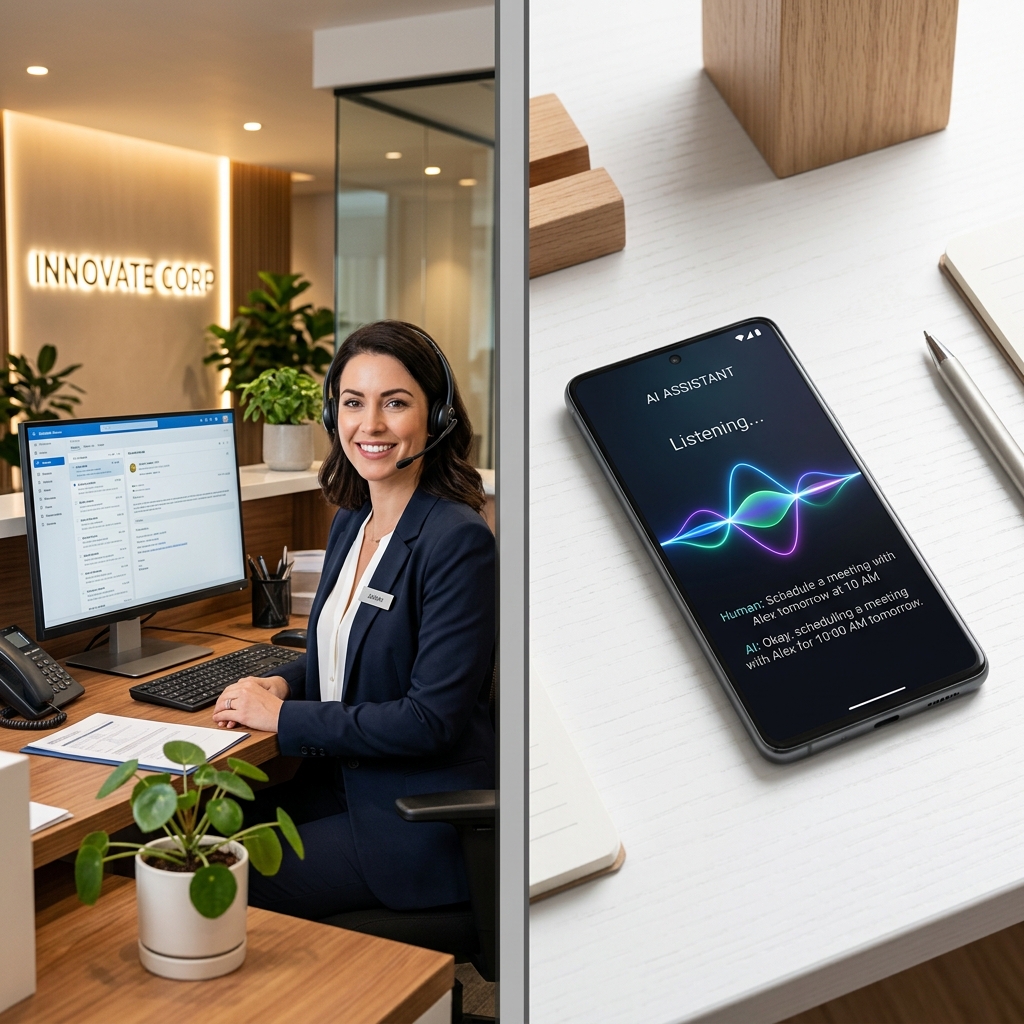
A traditional answering service consists of human operators sitting in large call centres, answering calls on your behalf using your business name. When a customer calls, the operator follows a rigid script that you have provided in advance. They take the caller's name, number, and a brief message regarding the nature of the call.
While some can handle very basic FAQ responses, their primary function is message-taking. They charge per-minute (often $1.50 to $2.50) or per-call ($8 to $15). This means every call costs you money, regardless of the outcome. Furthermore, because these operators handle calls for dozens of different businesses simultaneously—from plumbers to lawyers to dentists—they cannot develop deep knowledge of any one business. If you want to change your script, it often incurs administration fees and takes time to implement.
What AI Receptionists Actually Do — In Detail
An AI receptionist, by contrast, uses advanced natural language processing to hold dynamic, back-and-forth conversations with your callers. Instead of reading rigidly from a script, it understands context, asks clarifying questions, and gauges urgency. It can confidently explain your services, pricing, and availability.
More importantly, an AI receptionist takes action. It connects directly to scheduling tools like Cal.com and Google Calendar to book appointments securely into your diary. If it detects a genuine emergency, it triages the situation and immediately alerts you via SMS. It operates 24/7 at a predictable flat rate, meaning it costs the same whether you receive ten calls or a hundred. Over time, during setup, it learns your specific business context, terminology, and preferences.
The Human Touch Advantage of Answering Services
To provide an honest assessment, we must acknowledge where traditional answering services excel: the human touch. Humans are inherently better at handling highly emotional callers. If a distressed elderly person calls about a flooded house, a genuine human voice offering immediate empathy can be incredibly reassuring.
Humans are also capable of using judgment in ambiguous situations that fall completely outside standard scripts. If a caller has a highly unusual request or a complex, multi-layered problem, a human operator can intuitively navigate the conversation. Additionally, a small percentage of callers simply prefer speaking to a living person and feel more comfortable knowing a human is on the other end of the line.
Where Answering Services Fall Short
The biggest failure of answering services is that they take messages, they don't take action. They cannot securely book a job into your calendar. They often don't know the difference between a minor blocked drain and a catastrophic burst main, meaning they treat every call with the same level of urgency. Quality varies wildly between individual operators; you might get a great operator one day and a disengaged one the next.
Cost is another major shortfall. Per-minute billing actively punishes you during your busiest periods when you need the most help. If you want after-hours coverage, the call centre passes their penalty rate costs directly to you in the form of hefty surcharges. Finally, updating your business information or scripts costs time and money, making them inflexible as your business evolves.
The Consistency Advantage of AI
AI receptionists offer unparalleled consistency. An AI never has a bad day, never gets tired, and never rushes a caller off the phone because there are five other calls holding for different businesses. The quality of the interaction is exactly the same at 2 AM on a Sunday as it is at 10 AM on a Tuesday.
AI handles call surges effortlessly without any degradation in service quality. If a massive storm hits and fifty people call your roofing business at once, the AI answers every single one immediately. Furthermore, because of the flat-rate billing model, this massive surge in calls doesn't result in a punishingly high invoice at the end of the month. When your services or pricing change, you simply update the AI's knowledge base instantly—no training required.
Where AI Falls Short — Honest Limitations
AI is powerful, but it has genuine limitations. Highly emotional or panicked callers may find interacting with an AI frustrating if they are seeking deep human empathy. Very unusual requests that fall completely outside the scenarios you configured can confuse the AI, requiring it to fall back to a standard message-taking mode.
There is also a small subset of callers who fundamentally refuse to engage with AI once they realize it's not a human. Additionally, while speech recognition is excellent (especially with engines like ElevenLabs), extremely thick accents, heavy background noise, or very poor phone connections can sometimes challenge the system's accuracy. In complex, multi-party situations where several people are shouting over the phone, an AI will struggle more than a human would to parse the chaos.
Detailed Cost Comparison
Let's work through the real numbers. Imagine you use a traditional answering service and receive 100 calls per month, averaging 3 minutes each. That's 300 minutes. At an average of $2 per minute, you are paying $600 per month just for basic business hours coverage. If you need after-hours coverage, surcharges typically add 20% to 50%, pushing your total to $700-$900 per month for someone to simply take messages.
In contrast, a quality AI receptionist typically costs a flat rate of $50 to $100 per month for 24/7, unlimited coverage. The cost difference scales dramatically as you grow. If your call volume doubles to 200 calls per month, your answering service bill doubles to $1,400+, while your AI receptionist bill stays exactly the same. For growing trade businesses, the financial advantage of AI is undeniable.
Hybrid Approaches: Using Both
It doesn't have to be strictly one or the other. Many savvy businesses use a hybrid approach. For example, they might use an AI receptionist for after-hours and weekends to handle routine bookings and escalate genuine emergencies, while employing a human answering service (or in-house staff) during peak business hours for complex consulting calls.
Alternatively, some businesses use AI as their primary answering system 24/7, but set up rules to immediately seamlessly route highly complex or clearly distressed callers to a specialized human answering service. This approach gives you the cost-efficiency and direct booking power of AI, with the empathetic safety net of a human operator when it truly matters.
How to Choose the Right Option for YOUR Business
Choosing between the two requires a clear decision framework. If you have fewer than 20 calls a month and they are all highly complex consulting inquiries, an answering service might be the better fit. However, if you receive 50+ calls a month, including after-hours inquiries, AI is almost certainly more cost-effective.
If you absolutely need 24/7 coverage without breaking the bank, AI is the only realistic option for most small businesses. If the vast majority of your calls are straightforward requests for quotes, service bookings, or basic FAQs, AI excels because it can integrate directly with Cal.com or Google Calendar to finalize the job. If your calls are mostly highly emotional (e.g., a veterinary clinic or funeral director), lean towards human or hybrid options.
Migration: Switching from Answering Service to AI
Switching from a traditional answering service to an AI receptionist is straightforward but requires a brief transition period. The practical process involves porting or forwarding your business number to the AI system and disconnecting the old call centre routing. We highly recommend running a trial period where you test the AI internally before pushing it live to customers.
In the first week, expect a learning curve. You will likely review the call transcripts to see how the AI handles your specific customers, tweaking the knowledge base and instructions to refine its responses. Once dialed in, the transition is seamless, and most businesses wonder why they didn't switch sooner once they see the direct calendar bookings rolling in.
Frequently Asked Questions
Here are the most common questions businesses ask when deciding between AI and traditional answering services.